Monday, February 12, 2024

Murales, Tejido de Alfombras, Un árbol Muy Grande - Día Tres

The morning of the third day I got up feeling a bit under the weather. Travel has never been good to me and sometimes being out of my normal routine catches up with me. We ate another tasty breakfast and met up with our friends and then loaded back into the van. 

Our first stop was close to the hotel. It was an area in Oaxaca that has become famous for all of its artistically painted murals. On every block within this neighborhood are beautiful paintings. We walked and admired the workmanship on every wall.
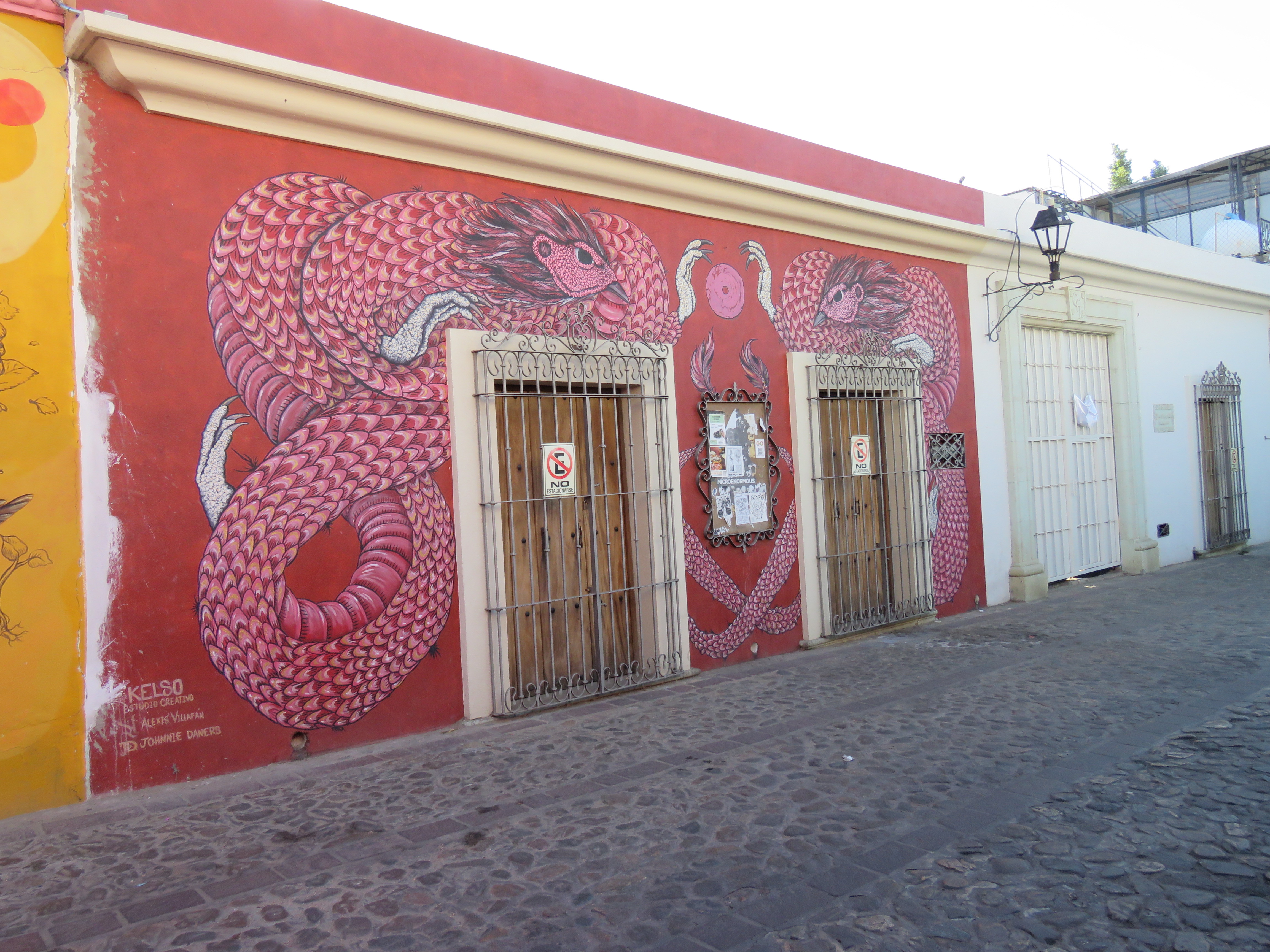
I took as many photos as I could and tried to capture the vision of each artist. The sun was a little bit of a problem casting harsh shadows on some of the walls. I did my best and we enjoyed the sights of this area. 

Just before we loaded back into the van I had to concede to my not feeling well and Eladio drove me quickly back to the hotel.

Linda remained with the group and carried on the rest of the day. I went to our room and layed down.


At about 11:30 am, I still felt bad so I decided that I should do something about my situation. This was all way out of my comfort zone, but I went down to the hotel front desk and inquired about a health clinic. They gave me directions, "Four blocks this way then two that!"  Off I went. I found the building they directed me to and it turned out to be a hospital. I stood outside wondering if this was the right thing to do. Should I just try to hang in there the rest of the trip? We still had three days of Oaxaca ahead and I felt I needed to deal with things.

In I wandered. I went to the front desk. With my translation app on my phone, I said I had a stomach problem. They motioned for me to sit and said, "Cinco minutos." In a short time, a doctor came out and led me back through the hospital to a room where I used my phone to communicate my symptoms. He did a quick check of my vitals and asked me a few questions about medication allergies. Then he layed me down on the bed and prodded and listened.  He communicated that my lower area was filled with gas and then he wrote me a prescription. I thanked him, we shook hands, and then he led me back to the front desk. I payed my bill, 500 pesos, and the nurse explained where the pharmacy was located, "Two blocks this way, three blocks that."

Off I wandered. At the pharmacy they could only full half the prescription. I paid and they gave me more directions, "Two blocks this way, two blocks that way."  I found the second pharmacy and filled the rest of the parscription. I walked out to the corner and noted I was a half block from our hotel. I laughed and hightailed it back to the room where I started the medication cycle. In the next 24 hours I felt 85% better and when the medication was complete I was back to normal.  I was sad that I had to miss the rest of that one day of our adventure, but glad that my little adventure has shown me that I could make my way on my own if something were to happen like this again.


I was sad to see that Dean needed to head back to the hotel. We decided I should continue with the group and not miss the day's activities.

After the murals, we hit the highway and headed to Teotitlan del Valle where we drove through the maze-like streets and stopped at our next destination. Here, we met a lovely family. This area of Oaxaca is known for it's beautiful rugs and we were in for a treat. 

We were invited in and asked to sit in a semi-circle. In front of us were skeins of colored wool and baskets filled with the natural ingredients used to dye the wool. Mama came around to all of us and put a pinch of rust-colored powder in each of our palms. Then water was added and we mixed up those two to see what we got. Next came a pomagranate seed. We crushed that and our reddish/orangish color turned to different shades of purple and magenta. 
After doing a bit of clean-up (though we all proudly carried our color on our palms for the rest of the day) Abuela showed us how to brush the wool to get a nice clump of soft fiber. She then took this wool to her spinning wheel and spun the wool into yarn. She made it look very easy, but it's not. This yarn is then dyed. They have to be very mindful of how much of a particular color of yarn they will need for their weaving because it's nearly impossible to try to match a color if you run out. 

Abuelo then asked us to follow him to his loom. He showed us how he weaves the different colored spindles to create their gorgeous tapestries. You can't tell in the picture, but he's not only having to count how many "stitches" he needs for each color he's using, he's also standing on two long pedals that move the main yarn up and down to make the actual weaving "easier". We were then given some time to ask questions and then look through the different items they had for sale. 

I knew I couldn't bring another rug home (we have many of them already and our luggage space was limited) so I wandered around until I spied handmade wool and leather purses. All of them were lined with a beautiful sapphire blue cloth. I found one I loved and bought it. 
I thanked the family and asked if I could take some picures of them. It was such a great morning. I felt very lucky to be able to have seen how they take rough natural wool and go through all of those processes by hand in order to create incredibly beauiful masterpieces.
A red powder with water creats the dye.

Then a pomagranate seed is crushed and added.


Our next part of our day took us to Tlacolula, famous for producing mezcal. This drink has grown more and more popular. It's at its best when it is produced using traditional methods. We were going to learn about its production. 

We went to the Don Agave (actually Dona Agave manages this now) distillery in Tlacolula. Christian was our guide through the process. They are an artisanal mezcal producer. He is very proud of the ranch and the alcohol they produce. Mezcal is made from the agave plant just like tequila. The difference comes in the distilling. Don Agave raises their own agave for most of the types of mezcal they produce. Any other agave needed, they buy from the grower themselves. 
After harvesting the agave, they put the pinas (the agave plant's core after the leaves are cut off) in a large pit that's layered with burning mesquite, layers of protection so the pinas don't burn too much, and then covered with a special soil. They cook for 6 days. They're then uncovered and crushed using a horse that walks the large stone crusher around. The liquid gathered is then distilled in large vats several times in order to get the alcohol content down between 40% and 55%. Flavor can be added at that time (this might include fruit, scorpion, spices,or a worm). They complete this entire process only once a month. 

Fields and fields of large agave.
Learning all of this was fascination, but what about the taste? We gathered under a shady palapa and Christian brought out 9 or 10 different mezcals to try. Yes, I tried them all. I did have to ask that my tastes be a bit smaller after the first 4 or 5. I also refused to sing "The Impossible Dream" which I tend to do after a couple of shots and goading from the crowd. Dean would have been proud. 
I enjoyed the experience and the taste. It has a very smokey flavor. My favorite was the one flavored with scorpion venom! I know, crazy, right?! They actually distill it with live scorpions. I probably won't switch from my favorite, tequila, but it was a fun time trying something new. After our tasting, we had an extremely delicious and much needed lunch at the ranch.

Empty burn pit ready for next smoking.

Burn pit in action. Smoking in progress.

After firing the smoked agave is crushed.

The mezcal is distilled in numerous vats.

Our last stop of the day was in the little village of El Tule where Arbor del Tule (the tree of El Tule) grows. This is said to be the widest tree in girth in the world - bigger even than the Sequoias. It measures 164 ft in circumference. This tree dwarfs the town's church and is more than 2000 years old. The local Zapotecs like to joke that the Tule tree shares some of their characteristics: it is short (116 ft), stout (38 ft in diameter), and old (2000+ yrs). El Arbor has its very own fiesta and celebration every October. We were told that the Pan American highway, which runs north and south all the way through the Americas, was re-routed so as not to disturb El Arbor's roots. This tree is sacred to this town. It was quite a sight.


Friday, February 09, 2024

El Mirador y Las Ruinas Número Uno - Día Dos

My girl all ready to explore.
Our FFD (First Full Day), began with a great breakfast provided by the hotel kitchen staff. Each day the staff would make us eggs, any way you like them, a meat, and fresh fruit. Coffee and tea was provided along  with bread snacks to get us fed and on our way for each adventure. The kitchen staff was so nice, we tipped them well and they really appreciated our gesture.

We started our day by loading into the van and Eladio snaked the rig through the traffic up to an overlook that give a panoramic view, the locales call this area El Mirador, a spot overlooking the valley where you can see all of the valley below.

Across from this lookout point you can see the many colors of the houses that clinging to the side of hills.  The colors create a montage that shimmers as the heat rises from the valley. A monument to Benito Juárez has been erected at this mirador. Rosario, our guide for the week, told us the story history of this man who is such a hero to so many in Mexico.

Heading out on the FFD.


Early morning view from our room.


Houses across from the mirador.

We drove down and across the valley, up the hillsides and onto the top of one of the many mountains that surround this city. There we entered Zona Arqueológica de Monte Albán . These ruins was one of the earliest cities in Mesoamerica. We were told that they have been dated back to 1000+ years before Christ.  There we spent the afternoon exploring the ruins and marveling at how advanced this culture was. They had water pools with running fresh water and they played sports in their facilities. The ruins we explored had been excavated and exposed, but there were said to be miles of undiscovered ruins hidden below the mountain tops. 


This map shows a overhead viiew of the 
excavation site.

Rosario explains the history of
this archeological site.


In the background, to the left,  you can see
El Mirador, if you know where to look.


View from the top of one of the pyramids.


The main sporting arena.


Huge rock slabs carved with pictographs 


The sports arena from the other direction.

They called this a Mexico Cotton Tree.


In the video below, the building that we're standing in front of is named after the Quetzal, a bird. The Quetzal is said to have magical qualities. Supposedly, if you stand in front of that building and you clap, because of the acoustics, instead of hearing hands clapping, the acoustics make a sound that is said to sound like the Quetzal bird. What do you hear?


The evening performance.


Wednesday, February 07, 2024

Explorandor - Día Uno

Over the past five weeks we have gotten into our daily life patterns and have acclimatized to the temperatures. It is time to change things up a little and go out and see more of Mexico.

Linda got an email from our friends Jill and Barry. They had set up a trip with a small group of four couples to travel to and explore the area around Oaxaca City and invited us to join their party.

Ruth hands out our boarding passes for the day.

Oaxaca City is located inland and south in the lower part of Mexico. To get there we had to take a van to the Manzanillo airport and fly Aeromexico to Mexico City where we transferred to a plane that flew for two hours south into the high country landing at the Oaxaca International Airport. This journey started at 8:00 am and we landed in our new destination at about 4:00 pm. This included a three hour lay over in Mexico City.

This long first day started a bit bumpy. Our tour company picked us up at our casa and rendevoused at Jill and Barry's home to load into a van for the airport. Just as we arrived at the meeting point, a group of Villa Orbregon taxis pulled in and blocked our van. The taxi drivers were not going to let a van from the airport pick up passengers in their territory.  This is not unusal. Taxis from the local towns around Manzanillo Airport can not pick up passengers at the airport proper, because the airport drivers won't allow them this option. There was much chatter and hand waving, but finally Ruth, the owner of Mex-Eco Tours, said it was not worth the delay and loaded us into three taxes.

Popocatepetl and Iztacciuatl
two volcanos from our plane.
The rest of our travel was uneventful and our Aeromexico flight landed (after a pretty turbulent entry) at the Mexico City Airport where we connected with one of the guides, Noel, and another Mex-Eco tour group from Puerta Vallarta. Noel lead us on to our plane that took us to our final destination for the day Oaxaca City.

At this point we met our van driver, Eladio, and our daily tour guide, Rosario. 

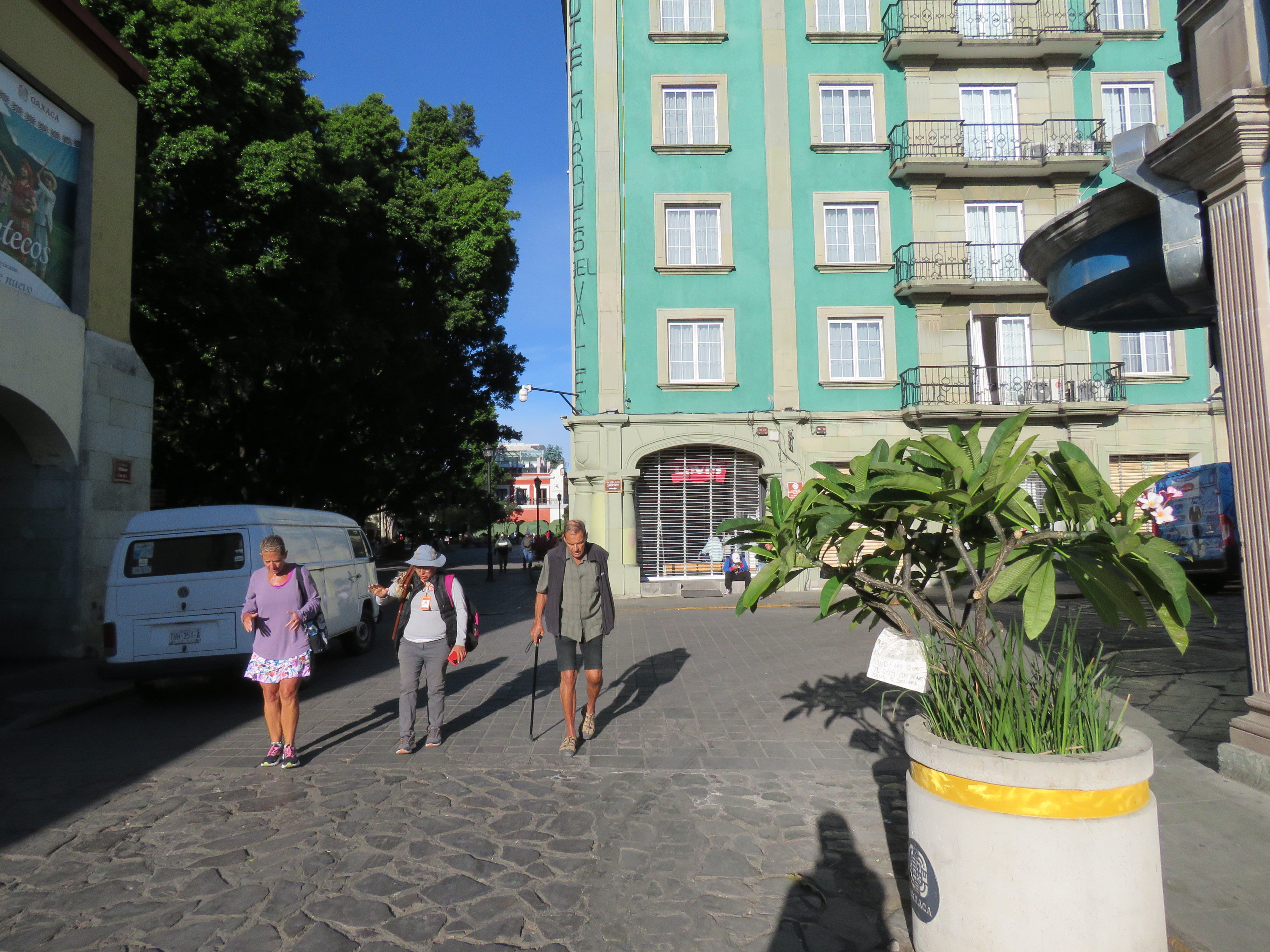
Our hotel, Hotel Marques del Valle, in Oaxaca’s historic centre was a wonderful home base for our stay and exploration. It was located on the main jardin for the historic center of the city. 

Our  hotel from the plaza.

She looks pretty good after a full day of travel.

Cathedral of Oaxaca, north side of zocalo.

Our hotel lobby at check-in.


Another view of the Cathedral.